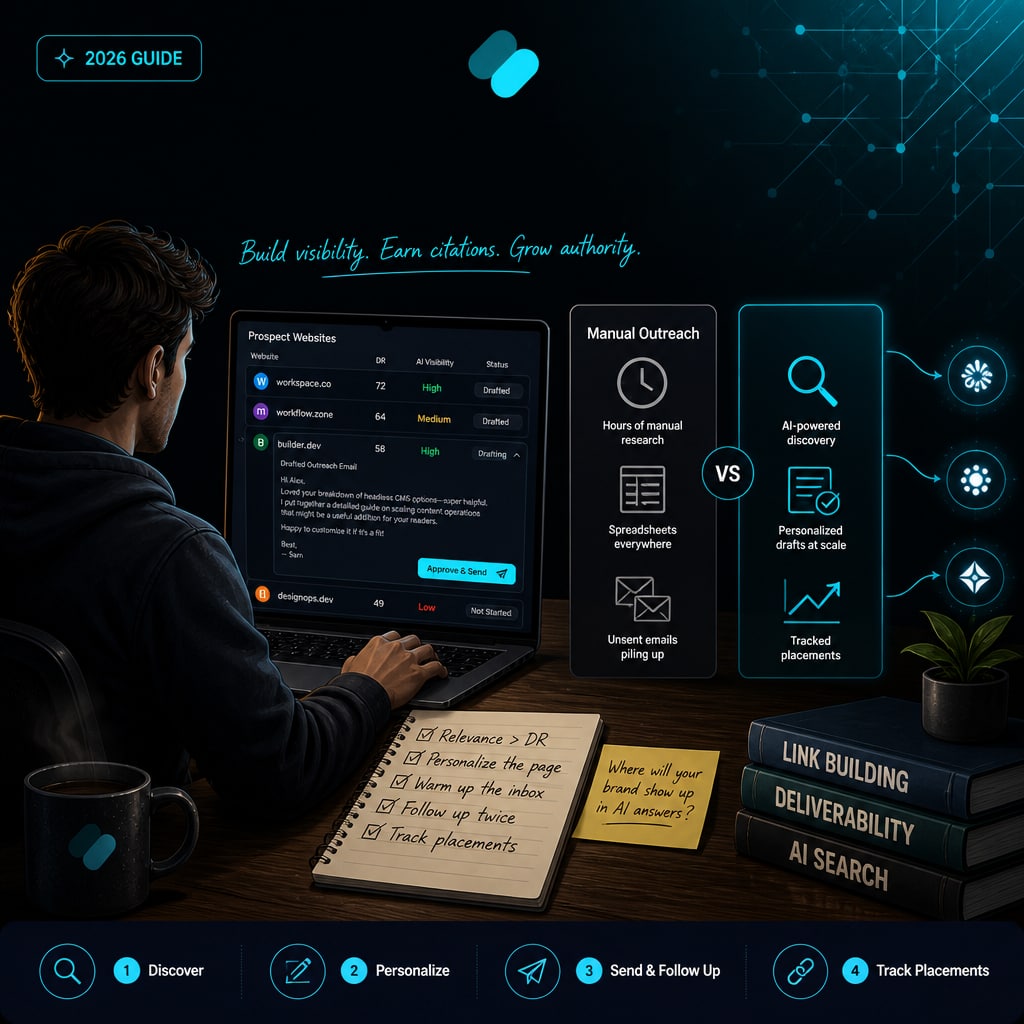
How to Get Backlinks on Autopilot With AI (Without Getting Flagged as Spam)
AI backlink outreach can find prospects, personalize pitches, and follow up automatically. Here is how to do it well without getting flagged as spam.

Backlink outreach breaks down into four repeatable jobs: find sites worth pitching, write something worth reading, follow up until you get an answer, and keep track of what actually went live. AI can now run most of that loop — but "on autopilot" and "unsupervised" are not the same thing, and the gap between them is exactly where campaigns get flagged as spam. Here's what actually works in 2026, and where a human still needs to be in the loop.
What "autopilot" actually automates
Split the outreach loop into its four jobs and it's clear which ones AI handles well and which ones still need a person:
- Discovery — scanning your niche for sites that already rank for your keywords, and filtering out low-quality or off-topic domains. AI does this fast and continuously; a person would only refresh the list occasionally.
- Personalization — reading a specific published page and writing a pitch that references it. AI can draft this at scale; whether the reference is actually accurate is worth a spot-check.
- Sending and follow-up — timing the first email and the two or three polite nudges that follow. Mechanical, and safe to fully automate once the sending domain is warmed up.
- Approval and relationship — deciding whether a pitch is good enough to send, and handling any reply that isn't a simple yes or no. This is the one job that stays human, and it's also the fastest one when the drafts in front of you are already good.
Done this way, testing across AI-assisted outreach campaigns has shown reply rates in the 25–40% range, against roughly 1–2% for generic cold outreach — the gap comes from relevance and personalization quality, not just volume.
Step 1: Find sites by relevance, not just authority
It's tempting to sort prospects by a single domain-authority number and work down the list. In practice, a mid-authority blog that covers your exact niche replies — and converts into a real, editorially placed link — far more often than a high-authority site with no topical overlap. Relevance is what makes a pitch worth opening in the first place; authority is what the link is worth once you have it. Weight both, but don't let authority alone decide who gets pitched.
A useful filter: does this page already rank for a keyword you also target, or does it link out to sites that do? If yes, the site's audience already overlaps with yours, and a pitch referencing that specific page reads as relevant rather than random. In practice, a prospect worth pitching usually clears most of these:
- The page ranks for, or is clearly about, a keyword your own site also targets — not just the same broad category.
- It already links out to at least one other independent site, showing the publisher is willing to cite others, not just self-promote.
- It's been updated or published recently enough that a "this is now out of date" pitch is credible.
- The site publishes real, dated posts under a named author or team — not an anonymous "resources" page that exists only to sell links.
Step 2: Personalize the page, not the name
Swapping in a first name is not personalization — it's a mail merge with extra steps, and most publishers can tell within a sentence. A pitch that cites the specific gap in a specific published article — the section that's out of date, the angle it didn't cover, the stat it's missing — reads as research. That's the difference between a pitch that gets deleted and one that gets a reply.
This is also where AI genuinely earns its keep: reading a page and finding its actual gap is exactly the kind of research task that scales badly for a human doing 50 pitches a day, and scales fine for a model doing the same reading task 50 times before breakfast. The catch is that it needs to be reading the real page, not guessing from a title — a pitch that misreads the article is worse than a generic one.
Step 3: Protect the domain you're sending from
However good the pitch, high daily volume from a domain with no sending history gets flagged — by spam filters, and eventually by the publishers who stop opening your mail at all. This is the step every "backlinks on autopilot" pitch glosses over, because it's the least exciting part and the easiest to get wrong.
In practice, that means three concrete limits, not vague advice to "go slow":
- Warm up before you scale. A brand-new sending domain should start at a handful of emails a day and step up gradually over several weeks, not launch at full volume on day one.
- Cap sends per day, even once warmed up. A lower, sustained daily cap outperforms a burst-and-pause pattern — inbox providers weight consistency.
- Space out follow-ups. Two or three days between touches, not same-day nudges — a fast campaign that lands in spam folders is slower than a paced one that doesn't.
A realistic ramp for a fresh sending domain looks like this — slower than most people expect, and the reason most "autopilot" campaigns that skip it stall out in week two:
- Week 1: 3–5 emails a day, no follow-ups yet — the inbox is still establishing a sending pattern.
- Weeks 2–3: 8–15 a day, first follow-ups begin on the earliest sends.
- Weeks 4–6: 20–30 a day, full follow-up cadence running.
- Week 6+: hold at a sustainable daily cap rather than continuing to climb — more volume stops paying off once reply rate per send starts dropping.
A slower campaign that stays out of spam folders will always out-perform a fast one that doesn't — there's no volume of sends that recovers a domain's deliverability once it's been flagged.
Step 4: Follow up — most "yes" replies aren't to the first email
The majority of positive replies in outreach campaigns come from a second or third touch, not the opener. A short, polite follow-up two or three days later, referencing the original pitch rather than repeating it, recovers a meaningful share of prospects who simply didn't see — or didn't get to — the first email. This is the easiest step to automate safely, since a follow-up schedule doesn't need judgment, just consistent timing.
Step 5: Track placements, not just sends
A backlink campaign isn't done when the email is sent — it's done when the link is live and stays live. Sites redesign, archive old posts, or quietly drop links during a content cleanup, and a link that disappears six months later still shows up as "placed" in a dashboard that only tracks sends. Checking on placements periodically, and being ready to re-pitch when one drops, is what keeps your link graph trending up instead of slowly leaking away.
What not to automate
"Autopilot" has a bad reputation in link building because a real version of it — mass-buying links, trading reciprocal links in bulk, or running content through a network of low-quality sites built only to host outbound links — genuinely does get sites penalized. None of that is what's described above, but it's worth naming directly, because the tools that offer it often use the same "backlinks on autopilot" language:
- Private blog networks and link farms. A cluster of sites that exist only to link out is detectable precisely because it's automatable at scale — the same pattern that makes it easy to build makes it easy to flag.
- Bulk reciprocal or paid links with no editorial review. If a site will link to anyone who pays or links back, the link carries no relevance signal — for rankings or for AI citations — and sits at the center of most manual-action penalties.
- Auto-generated guest posts published without human review. A pitch a publisher wouldn't accept from a person doesn't become acceptable because a model wrote it faster; publishers who accept these usually aren't sites worth a link from in the first place.
The autopilot worth building automates the research and the logistics — discovery, personalization, sending, tracking. It doesn't automate away the judgment call of "would a real editor publish this," because that judgment call is what keeps a link profile looking earned instead of manufactured.
The part most guides skip: backlinks feed AI visibility too
Every guide to automating backlinks treats the goal as ranking higher in Google. That's still true, but it's now half the picture. ChatGPT, Perplexity, and Google's AI Overviews all draw their answers from the same web of citations that search rankings do — a site that earns real editorial links from relevant, topically-aligned sources doesn't just rank better, it gets cited more often when someone asks an AI engine a question in your niche.
That link doesn't need to point at your homepage to matter here. A mention on a site an AI engine already trusts and cites in your category carries weight even before anyone clicks through — which is why relevance (Step 1) matters more for AI visibility than it did for classic SEO. A hundred low-relevance links move a domain-authority number; a handful of links from sites that already show up in AI answers for your keywords move whether you show up too. Tracking which AI engines cite you, and how that shifts as your backlink profile grows, closes the loop between outreach effort and the outcome that increasingly matters.
Build it yourself, or run it on an agent
Both paths work. The difference is what you're trading for what:
| Build it yourself | Run it on an agent |
|---|---|
| Stitch together a prospecting tool, an email finder, and a sequencing platform | One connected workflow: discovery, drafting, sending, and tracking in one place |
| You configure warm-up, send caps, and follow-up timing yourself | Deliverability limits are enforced automatically as the inbox warms up |
| You review every draft, since nothing reads the target page for you | Drafts arrive referencing the specific page — you approve or skip |
| Placement tracking is a separate spreadsheet, if it happens at all | Placements and drops are tracked against the original pitch automatically |
| Best if you already run a marketing stack and want full control | Best if you want the loop running without assembling and maintaining the stack |
Neither path removes the human step from approval — the difference is how much setup and maintenance sits on top of it. FuxuxRank runs the agent path: it finds relevant prospects, drafts a pitch that cites their actual page, sends and follows up from a warmed-up inbox with built-in send caps, and tracks every placement — you approve the drafts and close the relationships that need a real conversation. It's free to start, with no card required to see your first batch of prospects.
FAQ
How fast can I expect my first backlink?
Once a sending inbox is connected and warmed up, the first replies typically arrive within one to two weeks, with placed links following as publishers act on a "yes." The warm-up period itself — a few weeks of gradually increasing send volume — is the main variable; skipping it to move faster is what causes campaigns to stall on deliverability instead.
Will AI outreach get my domain flagged as spam?
Volume and personalization are what get a domain flagged, not the fact that AI wrote the draft. A templated blast at full volume from day one will get flagged whether a human or a model wrote it; a warmed-up domain sending personalized, page-specific pitches at a sustainable daily cap generally won't.
Do I still need to review anything myself?
Yes — approval is the one step worth keeping human. Reviewing a drafted pitch for accuracy before it sends takes seconds and catches the rare misread page; skipping that step to go fully hands-off is where quality (and reply rates) slip.
What's a safe daily send volume when starting out?
Start in the single digits on a brand-new domain and step up gradually over several weeks rather than jumping to a target number immediately — the ramp matters more than the eventual ceiling, and a lower sustained cap consistently beats a fast ramp that trips a spam filter.
Ready to build backlinks on autopilot?
FuxuxRank finds the sites, writes the pitch, and follows up — so you can focus on the deals.
Launch my agent for free