How to Get Cited by ChatGPT and Google AI Overviews (A Practical Checklist)
AI citations and backlink outreach aren't two separate jobs. The practical checklist for getting cited by ChatGPT, Perplexity, and AI Overviews.

Most "how to get cited by AI" guides read like a second SEO checklist bolted onto your first one — schema markup, quotable answer blocks, an llms.txt file, and then, buried around item four or five, "build backlinks." Treated that way, AI citation work becomes a whole second job. It isn't one. If you're already running backlink outreach, the same campaign is your AI-citation strategy — you're just choosing different targets and reading the results differently.
What actually earns a citation
AI engines don't rank ten blue links — they retrieve a handful of passages that answer the question well, then check whether the source is trustworthy enough to quote. That's two separate bars. A page can be perfectly extractable — clear structure, a direct answer up top — and still never get cited, because nothing about the source told the model it was safe to trust.
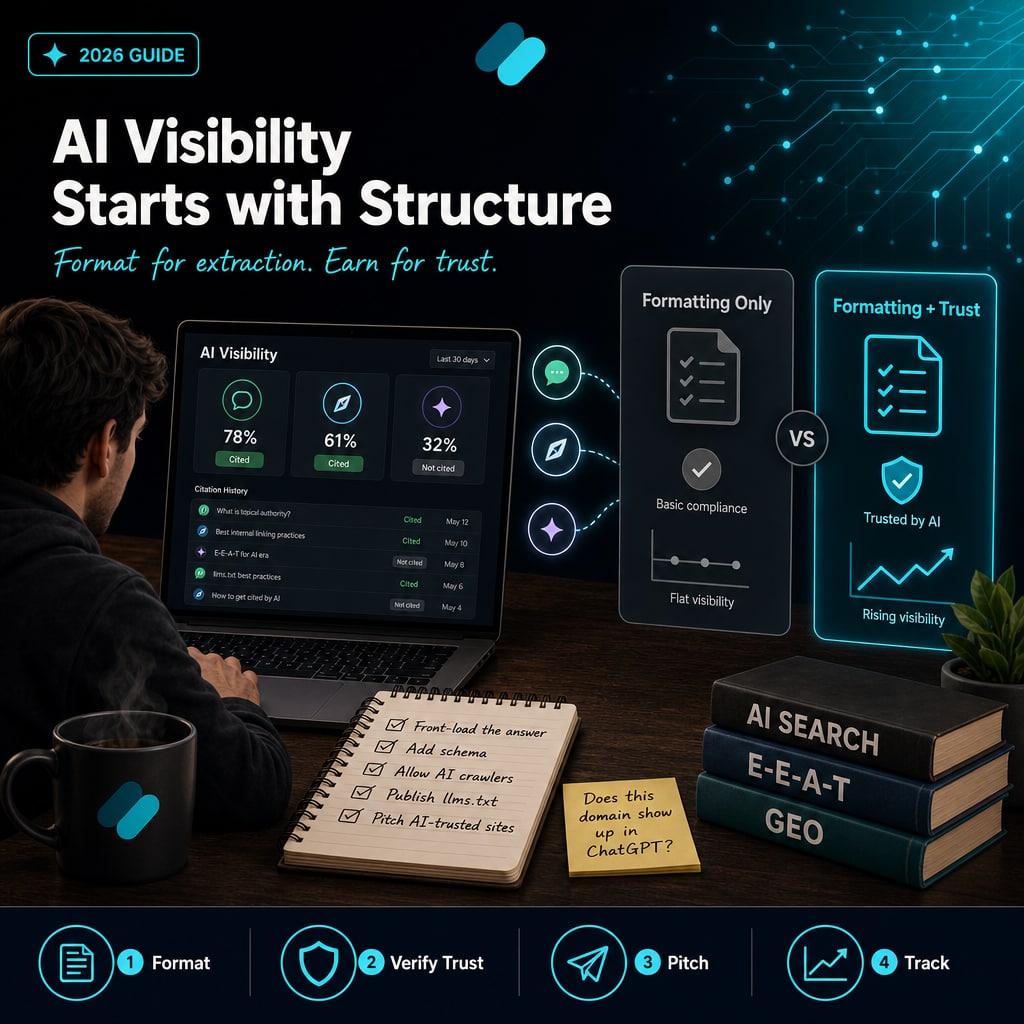
Extractability is a formatting problem. Trust is a reputation problem. Most guides spend 90% of their word count on the first bar and one bullet point on the second — which is backwards, since the second bar is the one that actually keeps changing week to week as your site earns (or doesn't earn) real signals elsewhere on the web.
The three engines don't weigh the same things
Optimizing for "AI search" as one target is the second-most common mistake in this space, after ignoring trust entirely. ChatGPT, Perplexity, and Google AI Overviews pull from different pools and reward different things:
| Engine | Leans on | Rewards most |
|---|---|---|
| ChatGPT | Broad, established sources — Wikipedia shows up disproportionately often | Depth and a clear, front-loaded answer over raw novelty |
| Perplexity | Recently published or updated pages, community discussion | Freshness — a page updated this month outperforms a static one |
| Google AI Overviews | Sources that already clear Google's own authority bar | E-E-A-T signals — the same trust markers classic SEO already rewards |
The practical takeaway: a site that's a strong ChatGPT source and a site that's a strong Perplexity source aren't always the same site. When you're checking whether a prospect is AI-trusted (next section), check more than one engine — a domain can clear one bar and miss another entirely.
The formatting checklist, quickly
This part is genuinely table stakes, and several other guides already cover it well, so here it is at the pace it deserves — get these right, then spend your actual time on the section after it:
- Front-load the answer. Open each section with a direct, quotable 1–2 sentence answer before the supporting detail — a model lifting a passage takes the first clear statement it finds, not the best-argued one three paragraphs down.
- Add schema markup. JSON-LD that states what the page is, who wrote it, and what it claims removes ambiguity a model would otherwise have to guess at.
- Let the crawlers in. Check robots.txt allows GPTBot, OAI-SearchBot, PerplexityBot and Google-Extended — a technically perfect page nobody's allowed to read never gets cited.
- Publish an llms.txt. A plain-text index of your most important pages, at the domain root — cheap to make, and it's the one item on this list that takes minutes, not hours.
- Keep dates visible and honest. Perplexity in particular favors recently-updated pages; an "Updated" date that's actually true is worth more than a full rewrite you don't keep current.
The part that's actually backlink work
Here's the reframe: earning a mention on a site an AI engine already trusts and cites in your category does two things at once. It's a real, editorially-earned backlink — the same asset classic SEO has always valued. And it puts your brand inside a source the model already treats as credible, which matters more for AI citations than a mention on a site with no AI-trust standing at all, even at a higher domain authority.
That changes what "a good prospect" means. The question isn't just "does this site rank," it's also "does this site show up when I ask an AI engine about this topic." A few concrete signals worth checking before you pitch:
- Ask the AI engines directly. Query ChatGPT, Perplexity, and Google AI Overviews with a handful of questions in your niche and note which domains keep showing up as sources — that's your actual target list, not a domain-authority spreadsheet.
- Prefer sites AI engines already lean on. Wikipedia, established trade publications, and government or academic sources show up disproportionately across all three engines — a mention on one of these carries weight a random blog post won't, regardless of its own traffic.
- Weight recency the same way the engines do. A site that publishes and updates often reads as more trustworthy to a retrieval system than one with a static archive from 2019, even if the archive is technically still accurate.
- Look for structured, sourced writing. Sites that already cite their own sources and write in a direct, answer-first style are more likely to be the kind of source a model quotes from — and more likely to accept a pitch written the same way.
None of this replaces the relevance filter from a normal outreach campaign — you still want a topical match, not just AI-trust for its own sake. It's an additional filter on top, not a different campaign.
Finding these prospects without starting from scratch
If you're already discovering prospects by searching your own keywords — which is how relevant backlink targets get found in the first place — you're most of the way there already. The sites that rank on page one for your commercial keywords overlap heavily with the sites AI engines pull from for the same topic, since both are pointing at whoever already demonstrates authority on the subject.
The workaround for the rest: run the AI-engine-query check above against your existing prospect list before you pitch, not as a separate research project. A prospect that clears both bars — ranks for your keyword and shows up as an AI citation source — is worth moving to the top of the queue over one that only clears the first.
Say you're pitching outreach-automation content and your keyword search already surfaced a mid-authority marketing blog and a well-known industry publication. Domain authority alone might rank them close together. But if the industry publication also turns up when you ask ChatGPT and Perplexity a related question, and the blog doesn't, that's the one worth prioritizing this week — same relevance, materially different payoff. This is exactly the same relevance-first prospecting covered in our guide to automating backlink outreach, with one more filter layered on.
Where this goes wrong
A few patterns show up often enough to call out on their own:
- Optimizing formatting and stopping there. A perfectly extractable page on a domain with no trust signal anywhere still doesn't get cited — the checklist section above is necessary, not sufficient.
- Chasing domain authority instead of AI-trust. The two correlate but aren't the same measurement, and treating them as interchangeable means pitching the wrong sites for this specific goal.
- Checking once and calling it done. Citations shift as retrieval indexes refresh — a single "yes, we're cited" check is a snapshot, not a result you can rely on next month.
- Running AI-citation outreach as a separate project. Splitting budget and attention across two campaigns instead of one filtered campaign means doing twice the outreach work for prospects that mostly overlap anyway.
Track it, or you're guessing
Citations aren't stable the way a backlink is — the same question can return a different set of sources next week as engines re-run retrieval. That means a one-time check tells you almost nothing; what matters is the trend as your backlink profile grows. Pick five or six real questions a prospective customer would ask, run them against ChatGPT, Perplexity, and Google AI Overviews monthly, and log whether you show up. It's tedious to do by hand, which is exactly why it's worth checking — FuxuxRank's Pro plan includes an AI Visibility dashboard for tracking citations across engines over time, alongside the backlink outreach itself.
FAQ
Do I need a separate strategy for AI citations versus regular SEO?
No — the overlap is large enough that a single backlink campaign, aimed at relevant and AI-trusted sites, covers both. Treat AI citation as an extra filter on prospect quality, not a parallel workstream with its own budget and timeline.
Does domain authority still matter if a site isn't AI-trusted?
It still matters for classic rankings, but it's not a reliable proxy for AI citation likelihood on its own — a mid-authority site that AI engines already cite in your niche can outperform a higher-authority site with no AI-visibility footprint. Check both, weight neither alone.
How long before a new backlink shows up as an AI citation?
There's no fixed timeline — it depends on how often the source page gets re-crawled and how the model's retrieval index refreshes, which varies by engine. Perplexity tends to reflect changes fastest given its emphasis on freshness; Google AI Overviews and ChatGPT are slower and less predictable. Track monthly rather than expecting an immediate signal.
Is an llms.txt file actually necessary?
It's not required — pages get crawled and cited without one — but it's cheap enough (a plain text file, minutes to write) that skipping it saves no meaningful effort. Treat it as a small, easy item on the checklist, not a priority over the backlink work above it.
Ready to build backlinks on autopilot?
FuxuxRank finds the sites, writes the pitch, and follows up — so you can focus on the deals.
Launch my agent for free